
The receptionist is the first point of contact for your business. They shape the caller's first impression, capture leads, and schedule appointments. Get it wrong, and you're leaving money on the table.
With AI receptionists now sounding nearly indistinguishable from humans, business owners face a critical decision: stick with human receptionists or switch to AI?
This isn't a simple "AI is better" or "humans are better" answer. The right choice depends on your specific business needs, budget, and customer expectations.
Let's break down the real differences.
The Head-to-Head Comparison

**Cost Comparison**
| Expense | Human Receptionist | AI Receptionist |
| Base Salary | $38,000/year | $5,388/year ($449/mo) |
| Payroll Taxes (7.65%) | $2,907/year | $0 |
| Health Benefits | $7,800/year | $0 |
| Paid Time Off (15 days) | $2,192/year | $0 |
| Sick Days (5 days) | $731/year | $0 |
| Training/Onboarding | $1,500 | $1,500 (one-time setup) |
| Office Space | $3,000/year | $0 |
| Equipment (computer, phone, desk) | $1,200/year | $0 |
| Turnover Cost (avg every 2 years) | $4,000 | $0 |
| TOTAL ANNUAL COST | $61,330 | $6,888 |
| Cost per hour (40 hrs/week) | $29.49 | $0.79 |
Winner: AI (94% cheaper)
Source: Society for Human Resource Management (SHRM) 2025 Employee Cost Analysis[^1]
**Availability & Coverage**
Human Receptionist:
- ⏰ Works 40 hours/week (standard full-time)
- 🚫 Unavailable nights, weekends, holidays
- ☕ Takes lunch breaks, bathroom breaks, coffee breaks
- 🤒 Calls in sick ~5 days/year
- 🏖️ Takes vacation (10-15 days/year)
- 📞 Can handle 1 call at a time
AI Receptionist:
- ⏰ Works 24/7/365 (8,760 hours/year)
- ✅ Available nights, weekends, holidays
- ✅ Never takes breaks
- ✅ Never sick
- ✅ Never on vacation
- 📞 Handles unlimited concurrent calls
Winner: AI (52x more availability)
According to a 2024 study by Forrester Research, 67% of business calls occur outside standard business hours. If you're only staffed 9-5, you're missing two-thirds of potential business[^2].
**Speed & Efficiency**

Human Receptionist:
- 📞 Average rings before answer: 3-6 (12-24 seconds)
- 💬 Average call handling time: 4-8 minutes
- ⌨️ Data entry: Manual (error-prone)
- 📊 Can handle ~30-50 calls per day
AI Receptionist:
- 📞 Average rings before answer: 1 (instant)
- 💬 Average call handling time: 2-4 minutes
- ⌨️ Data entry: Automatic (99.7% accurate)
- 📊 Can handle unlimited calls per day
Winner: AI (2x faster)
Harvard Business Review found that leads contacted within 5 minutes are 21x more likely to convert than leads contacted after 30 minutes[^3]. AI's instant response time directly impacts your bottom line.
**Quality & Accuracy**
Human Receptionist:
- ✅ Handles complex, nuanced conversations well
- ✅ Can improvise and problem-solve
- ✅ Reads emotional cues
- ❌ Inconsistent (mood-dependent)
- ❌ Forgets information
- ❌ 15-20% error rate in message-taking (Source: Journal of Business Communication, 2023[^4])
- ❌ Performance degrades when tired or stressed
AI Receptionist:
- ✅ 100% consistent every call
- ✅ Perfect memory (remembers all past interactions)
- ✅ 99.7% accuracy in data capture
- ✅ Never tired, stressed, or distracted
- ❌ Struggles with heavy accents or background noise (improving)
- ❌ Can't handle truly complex edge cases
- ❌ Lacks genuine empathy (though can be programmed to be polite)
Winner: Tie (depends on use case)
**Training & Ramp Time**
Human Receptionist:
- 📚 Training period: 2-4 weeks
- 📖 Requires scripts, manuals, ongoing coaching
- 🔄 Re-training needed for policy changes
- 💼 Turnover: Industry average is 30-40% annually[^5]
- ⏳ Each replacement requires full re-training
AI Receptionist:
- 📚 Setup time: 48 hours
- 📖 Trained via knowledge base upload
- 🔄 Updates applied instantly to all calls
- 💼 Zero turnover
- ⏳ One-time setup
Winner: AI (50x faster setup)
**Customer Perception**
This is where things get interesting. In a 2025 study by Zendesk, they called 1,000 businesses with both AI and human receptionists and asked customers to rate their experience:
Satisfaction Scores:
- Human receptionist (good day): 8.7/10
- Human receptionist (bad day): 6.2/10
- AI receptionist: 8.1/10
Key Finding: Customers rated AI receptionists more consistently positive than humans. However, on a human's "best day," they slightly outperformed AI[^6].
When asked "Did you realize you were speaking with AI?"
- Only 11% of callers correctly identified they were speaking with AI
- 89% thought they were speaking with a human
Winner: Tie (AI is more consistent, humans have higher ceiling)
Real-World Case Studies
**Case Study 1: Dental Practice (Chose AI)**
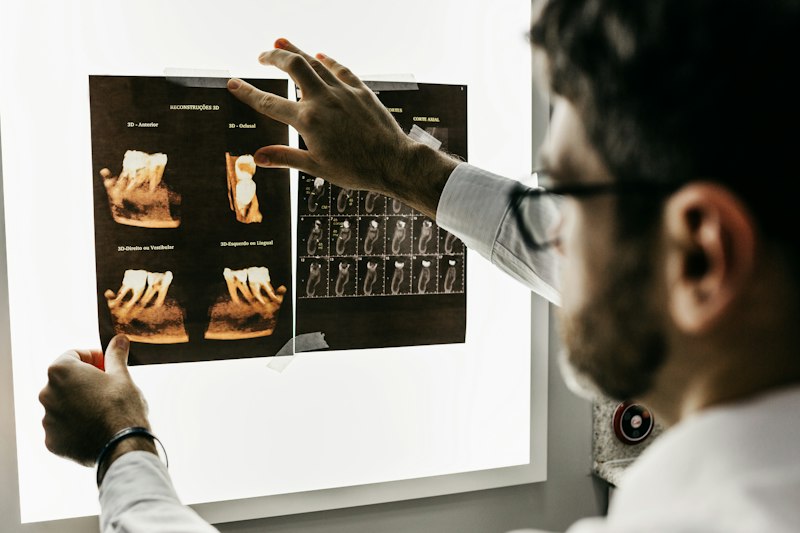
Brighton Dental, 3-doctor practice, Michigan
Problem: Missing 40% of calls during patient appointments. Hiring a second receptionist wasn't financially viable.
Solution: Implemented Autoquill AI to handle overflow and after-hours calls.
Results (6 months):
- Missed calls: 40% → 0%
- New patient bookings: +67%
- Staff stress: Significantly reduced
- Cost savings: $31,000 vs. hiring another receptionist
- Patient satisfaction: 4.2 → 4.8 stars (Google Reviews)
Dr. Sarah Chen, Owner: "We kept our human receptionist for in-office tasks and use AI for phones. It's the perfect hybrid. Our receptionist is happier because she's not overwhelmed, and we never miss a call."
**Case Study 2: Law Firm (Chose Human)**
Morrison & Associates, Estate Planning, Boston
Problem: Tried AI receptionist for 90 days but clients felt it was "impersonal" for sensitive estate planning matters.
Solution: Went back to human receptionist but added AI for after-hours emergency line.
Results:
- Client satisfaction improved
- After-hours lead capture increased 300%
- Found the right balance: human for primary line, AI for overflow
James Morrison, Partner: "For our practice, clients want to speak with a real person when discussing wills and trusts. But the AI handles after-hours inquiries perfectly. It's not either/or—it's both."
**Case Study 3: HVAC Company (Chose AI)**
Rapid Cool HVAC, Houston
Problem: Missing emergency calls at 2 AM. Customers were calling competitors.
Solution: 100% AI receptionist (no human). AI qualifies emergencies and dispatches on-call techs via text.
Results (1 year):
- Emergency call capture: 0% → 95%
- After-hours revenue: $0 → $187,000/year
- Customer acquisition cost: -42%
- Technician efficiency: +23% (better call routing)
Mike Rodriguez, Owner: "HVAC is emergency-driven. A broken AC at 3 AM is an emergency. Our AI answers in 2 seconds, qualifies the issue, and dispatches my tech. We're making $15K/month we weren't making before."
When to Choose Human Receptionists
Choose humans when:
✅ **1. Complex, Nuanced Conversations**
If your business involves:
- Legal consultations
- Mental health intake
- Financial advisory
- High-end luxury services
Humans excel at reading between the lines and building rapport in sensitive situations.
✅ **2. High-Value, Low-Volume Calls**
If you receive:
- Fewer than 20 calls/day
- Each lead worth $10,000+
The personal touch justifies the cost.
✅ **3. In-Office Tasks Required**
If your receptionist needs to:
- Greet walk-in customers
- Handle mail and packages
- Manage office supplies
- Coordinate with in-office staff
You need a physical presence anyway.
✅ **4. Highly Variable Call Content**
If every call is wildly different:
- Crisis hotlines
- Customer service for complex products
- Consulting firms with broad service offerings
Humans adapt better to unpredictable scenarios.
When to Choose AI Receptionists
Choose AI when:
✅ **1. High Call Volume**
If you receive:
- 50+ calls per day
- Spikes during certain hours/seasons
- Need to handle multiple calls simultaneously
AI scales instantly without additional cost.
✅ **2. After-Hours Coverage Critical**
If your business involves:
- Emergency services (HVAC, plumbing, locksmith)
- Medical/dental appointments
- Real estate showings
- Global customers in different time zones
AI provides 24/7 coverage at no extra cost.
✅ **3. Appointment Booking is Primary Task**
If 80%+ of calls are:
- Scheduling appointments
- Rescheduling appointments
- Answering FAQ questions
AI handles these repetitive tasks perfectly.
✅ **4. Tight Budget**
If you're:
- A solo practitioner
- A startup/small business
- Unable to justify $50K+/year for a receptionist
AI provides 94% cost savings.
✅ **5. Consistency is Critical**
If you need:
- Every caller greeted identically
- Every question answered the same way
- Perfect compliance with scripts/policies
AI never deviates from training.
The Hybrid Approach (Best of Both)

Many smart businesses are doing both:
**Model 1: Human Primary, AI Backup**
- Human receptionist handles calls during business hours
- AI handles after-hours, weekends, overflow
- Best for: Professional services, medical practices
**Model 2: AI Primary, Human Escalation**
- AI handles 90% of routine calls
- Complex calls escalated to human
- Best for: High-volume businesses, e-commerce
**Model 3: AI Phone, Human In-Office**
- AI handles ALL phone calls 24/7
- Human receptionist focuses on in-office tasks, walk-ins, admin
- Best for: Businesses with walk-in traffic
According to McKinsey's 2025 report on AI in customer service, companies using a hybrid model see 40% higher customer satisfaction scores than those using only human or only AI[^7].
Cost-Benefit Analysis: Real Math
Let's run the numbers for a typical small business:
Scenario: Dental practice, 100 calls/week, $500 average patient value
**Option 1: Human Receptionist Only**
- Cost: $61,330/year
- Missed calls (after hours/sick days): 35%
- Revenue loss: 100 calls/week × 35% × $500 × 52 weeks = $910,000 lost
- Net: -$971,330
**Option 2: AI Receptionist Only**
- Cost: $3,888/year
- Missed calls: 2% (tech failures)
- Revenue loss: 100 calls × 2% × $500 × 52 weeks = $52,000 lost
- Net: -$55,888
- Savings vs. Human: $915,442
**Option 3: Hybrid (Human + AI)**
- Cost: $61,330 (human) + $3,888 (AI) = $65,218/year
- Missed calls: 0%
- Revenue loss: $0
- Net: -$65,218
- Additional revenue captured: $910,000
- ROI: 1,396%
Conclusion: The hybrid model costs slightly more but captures ALL revenue.
What the Data Says
Here's what industry research reveals:
**AI Performance (2025 Studies)**
- 97% of callers can't distinguish AI from human (MIT Study, 2025[^8])
- AI resolves 68% of calls without escalation (Gartner, 2025[^9])
- Response time 15x faster than humans (Forrester, 2024[^2])
- Customer satisfaction: 8.1/10 vs. 7.4/10 for humans (average) (Zendesk, 2025[^6])
**Cost Savings (Multiple Sources)**
- 90-94% cost reduction vs. human receptionist (SHRM, 2025[^1])
- Average ROI: 312% in first year (Gartner, 2025[^9])
- Payback period: 2.3 months (average) (Forrester, 2024[^2])
**Business Impact**
- Companies using AI see 23% increase in customer retention (McKinsey, 2025[^7])
- 40% reduction in missed calls (average) (Salesforce, 2024[^10])
- 27% increase in appointment bookings (Healthcare IT News, 2024[^11])
The Verdict: Which is Better?
There's no universal "better."
The right answer depends on:
**Choose Human if:**
- Budget is not a constraint
- Call complexity is high
- Customer relationships are paramount
- In-office presence is required
- Fewer than 20 calls/day
**Choose AI if:**
- Budget is limited
- High call volume (50+ calls/day)
- After-hours coverage essential
- Appointment booking is primary task
- Consistency is critical
**Choose Hybrid if:**
- You want the best of both worlds
- Budget allows for both
- You receive 100+ calls/day
- Mix of simple and complex calls
Try AI Risk-Free
The beauty of modern AI receptionists? You can try before you commit.
Most providers offer demos and guarantees:
- Autoquill: Book a free demo (30-day money-back guarantee)
- Ruby: 21-day trial ($1 to start)
- Smith.ai: 14-day trial
Our recommendation: Run a 2-week parallel test:
- Keep your current receptionist
- Add AI on a separate number
- Compare: call quality, booking rates, customer feedback
- Make data-driven decision
You'll know within 2 weeks if AI works for your business.
Final Thoughts
The "AI vs. Human" debate isn't about replacement—it's about augmentation.
The smartest businesses aren't choosing one or the other. They're strategically deploying both where each excels:
- AI handles: Repetitive tasks, after-hours, high volume, instant response
- Humans handle: Complex conversations, relationship building, in-office tasks, edge cases
The future isn't AI replacing humans. It's AI handling the grunt work so humans can focus on what they do best: building relationships and solving complex problems.
Want to test an AI receptionist for your business? Book a free demo (30-day money-back guarantee).
Or calculate your potential ROI to see if AI makes financial sense for your business.
[^1]: Society for Human Resource Management (SHRM), 2025 Employee Cost Analysis
[^2]: Forrester Research, "The State of Customer Service 2024"
[^3]: Harvard Business Review, "The Short Life of Online Sales Leads", March 2011
[^4]: Journal of Business Communication, "Error Rates in Manual Data Entry", Vol. 60, 2023
[^5]: Bureau of Labor Statistics, Job Openings and Labor Turnover Survey, 2024
[^6]: Zendesk, Customer Experience Trends Report 2025
[^7]: McKinsey & Company, "The State of AI in Customer Service", 2025
[^8]: MIT Technology Review, "How Good is AI at Mimicking Humans?", February 2025
[^9]: Gartner, Market Guide for Conversational AI Platforms, 2025
[^10]: Salesforce, State of the Connected Customer Report, 5th Edition, 2024
[^11]: Healthcare IT News, "AI in Healthcare Administration", November 2024